The all-electric, Trail Rated 2026 Jeep Recon is finally here!
While the Wagoneer S has been on sale for a little while now, we’ve long known that Jeep had another electric SUV in the works, and one that’s more closely aligned to the brand’s off-road roots. Well, it’s finally here, and Jeep invited us out to Los Angeles to check it out as this week’s auto show prepares to kick off. With the time we had, Andre and I want to take you around the all-new, all-electric 2026 Jeep Recon and show you what’s what. We have all of the information you want to know, including how much the Moab model is going to cost. The Moab will be the first of two trims arriving in 2026, with the more street-focused Overland coming later on.


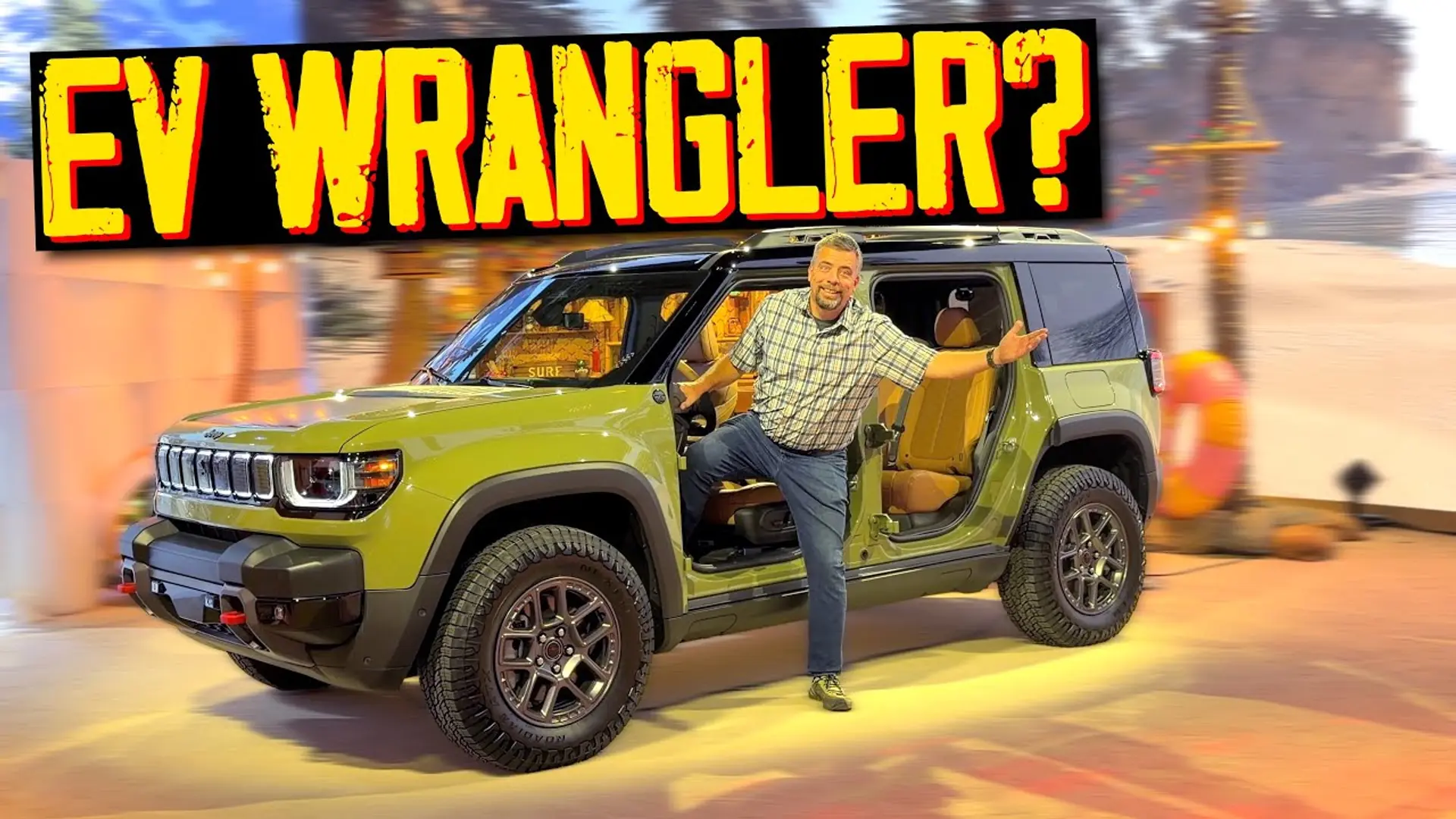
But first, let’s take a look around the 2026 Jeep Recon’s aesthetic details. From the front to the back, the Recon has a bolt-upright design, in a mindful nod to the brand’s iconic Wrangler SUV. Now, this is not an electric Wrangler, full stop, nor is the actual Wrangler going anywhere as a result of the Recon. Nevertheless, you do still get an (illuminated) seven-slot grille, proportions that are in the same ball park as the four-door Wrangler and the competition, and the Moab trim brings a set of recovery hooks, all-terrain tires and a selectable rear locker for good measure.
The 2026 Jeep Recon also adopts a few of the Wrangler’s party tricks to woo buyers intrigued at the thought of an electric off-roader. You can remove the doors, for a start, while you also get a swing gate and the back and the spare tire carrier. Like the Wrangler, passengers also get the customary grab handle. While you can’t fold down the windshield this time, you’ll be able to get plenty of off-road-themed gear like cowl lights, roof racks and a host of other accessories through the JPP catalog.
Jeep’s new Recon rides on the same STLA Large unibody platform as the Wagoneer S, so it is not body-on-frame like the Wrangler. While the Recon cribs some useful details, the two are fundamentally separate vehicles, with different dimensions to suit. Overall, the 2026 Jeep Recon rides on a 112.9-inch wheelbase and measures out to 193.3 inches overall, with an overall width of 87.4 inches (including the mirrors) and a roof height of 73.8 inches at the roof rails.

And the numbers keep coming with the 2026 Jeep Recon
But what about propulsion? Well, naturally, the 2026 Jeep Recon swaps an internal combustion engine for two 250-kilowatt electric motors. The result is an overall output of 650 horsepower and 620 lb-ft of torque. Interestingly, despite Jeep initially pitching the Wagoneer S as more of a sporty drive, the Recon is actually even more powerful, almost matching the Dodge Charger Daytona Scat Pack on paper.
With those performance figures in mind, here’s the other kicker: The 2026 Jeep Recon will do 0-60 in as little as 3.6 seconds…which the regular Wrangler (even the 392) most certainly will not. Now, you can rightly assert that acceleration isn’t the point of a dyed-in-the-wool Jeep and I’d agree with you, and it’s worth noting it’s still not particularly fast, as it tops out at 112 mph. Nevertheless, that power — and torque, specifically — will undoubtedly come in handy in some technical off-road scenarios.
The 2026 Jeep Recon’s rear electric drive motor packs a 15:1 final drive ratio, with the ability to select the e-locker in trickier situations. That said, it’s worth noting the Moab trim does not have a front locker like your Rubicon would, so the front drive motor with an 11:1 drive ratio has an open-differential configuration.
The new Recon sports 9.1 inches of available ground clearance, with approach, breakover and departure angles of 33.8 degrees / 23.3 degrees / 33.1 degrees respectively.
You do still get Jeep’s Selec-Terrain traction management system, though, which uses unique software calibrations (paricularly for Rock mode, which is unique to the Moab trim) to tailor throttle response to best fit the situation. In doing so, drivers can use both pedals to help meter out the best balance of braking to throttle application during more technical off-roading. The Recon also gets Selec-Speed Control that will maintain a set speed both up and downhill so the driver can concentrate on steering.

There is one number that’s not as big as you probably expect…
Thanks to the upright design, 33-inch all-terrain tires and all that grunt, there is one smaller number on the 2026 Jeep Recon…its range.
In this application, you get a 100.5-kWh lithium-ion battery pack with nickel manganese cobalt (NMC) chemistry. When all is said and done, that’s good for up to 250 miles of range, says Jeep…or 230 miles if you get the Moab. This EV also uses a 400-volt electrical architecture, so while you can DC fast-charge it, of course, it’s not as blazing fast as some of the up-and-coming EVs can manage. Provided you can find an appropriately quick charging station, the automaker says you can charge from 5% to 80% state-of-charge in about 28 minutes. Using a slower Level 2 AC charger takes about 7 hours to charge the same amount.
The Jeep Recon and other Stellantis electric vehicles use a CCS-style power rather than a “Tesla-style” NACS port, but Stellantis just announced today select BEV models in North America (including the Recon) would have access to Tesla’s Supercharger network early next year, and adapters will be available to buy at the Recon’s launch.
On one hand, automakers argue these days that range figures are considered to suit a vehicle’s actual real-world use, rather than just trying to pack in as much range as possible. To that end, Jeep avoided the sort of streamlined design that some folks lament on the Wagoneer S, so you do still have what looks like a blocky, boxy, beefy-looking off-roader. A proper Jeep, in other words. But you tell me: is 230 miles really enough for you? Especially if, say, you plan to actually take this out on the White Rim Trail for a day?
We will most likely (or hopefully, at least) get a chance to actually test that out in the coming months. Frankly, though, that is one area where Andre and I are both a bit skeptical, and we’re hardly alone in that impression.

Looking inside the Recon
Step inside, and the 2026 Jeep Recon is about as tech-forward as any other new vehicle under the Stellantis banner these days. So, you get a 12.3-inch digital driver cluster with a customizable display. You also get a 14.5-inch horizontally-oriented touchscreen in the center rocking the company’s latest Uconnect 5 operating system.
In fact, there aren’t many out-and-out buttons throughout the Recon’s interior, apart from standard buttons on the steering wheel and a small bank of switches below the HVAC vents. You also get a couple rocker switches for the drive modes and the e-locker. The climate controls are integrated into the screen, for better or worse, although you do still get physical volume and tuning knobs. The operating system also bakes in onboard pages for real-time insights for both off-roading and BEV features like Dynamic Range Mapping using the car’s onboard TomTom-based navigation system. The “Trails Offroad” app offers an onboard solution to trails in the U.S. and Canada, including pitch and roll mapping.
(On a side note, TFLoffroad channel sponsor onX Offroad also has a mapping app that works through Apple CarPlay, and the company has a 30% Black Friday deal for your first year’s membership using code “ORBF30” at checkout. You don’t have to buy a Jeep Recon to get it, either.)
The 2026 Jeep Recon’s interior also packs a host of other touches for the off-roader or daily driver. This electric SUV comes with a dual-pane sunroof by default, but you can spec it out with Jeep’s Sky One-Touch power top as an option. A Comfort Package also ups the available tech with ventilated front seats, a digital rearview mirror, an interior passenger camera and heated rear seats. If you’re looking to tow, a Trailer Tow Group package also adds in a Class III hitch receiver and a 4-/7-pin trailer connector. When properly equipped, the Recon can tow up to 3,300 pounds. Not a huge amount, by any stretch, but at least that’s enough wiggle room for a modestly sized camper (just take the range into account if you plan on doing that).


More interior touches and cargo space
If you do opt for the Moab trim, the new Recon introduces the Joshua Tree tan interior, in addition to the standard black option. Most of the cabin materials, including the seats, console, doors and instrument panel are finished in a non-leather synthetic material called “Capri”, with Iron Grey Metallic trim accents. In classic Jeep fashion, you get a host of “Recon” badges throughout the cabin from the instrument panel to the cargo area, as well as some fun easter eggs on the glass and the badging.
At the back, the 2026 Jeep Recon boasts up to 65.9 cubic feet of cargo space with the seats folded town. That figure also includes a 3.0 cu. ft. frunk, which is enough to store a carry-on sized suitcase or a bit of off-roading gear, if you don’t necessarily want to grab it from the back each time.
All right, when can I buy one and how much does it cost?
Jeep is targeting production first thing next year for the Moab trim specifically. The Recon Overland, its less hardcore trim, will arrive sometime later in the year (the company hasn’t announced a formal time frame beyond “late availability” just yet).
This is the part where you may want to sit down though: the price. As orders open up for the 2026 Jeep Recon, Moab models will set you back $66,995 to start ($65,000 plus $1,995 destination). In other words, that’s about $3,500 more than the swankiest Wrangler Rubicon X, and tens of thousands more than you’d spend on your base Wrangler models, though obviously without all the toys. At least you have more affordable options in the Wrangler lineup at present, but if you want to jump into Recon ownership, this is what you can expect to pay for now.
Check out more on the Recon in our debut video below, and stay tuned for more coverage from the LA Auto Show and our seat time in the Recon when we’re actually able to drive it early next year.
About the Author